Showing posts with label bestiary. Show all posts

24 November 2012

Many real animals are stranger than imaginary ones

Nature allows every child to play tricks with her; every fool to have judgment upon her; thousands to walk stupidly over her and see nothing; and takes her pleasure and finds her account in them all.
-- Goethe 
The wealth of the soul exists in images. I speak in images. With nothing else can I express the words from the depths. 
-- attributed to Jung

This post relates to Rereading: The Book of Imaginary Beings online at The Guardian. Short descriptions of a few imaginary creatures which Borges never knew can be found here.

In an essay published in 1971 the physician Lewis Thomas argued that a bestiary for our time would have to be a microbestiary, featuring the likes of Myxotricha paradoxa, Blepharisma and plant-animal combinations that mostly exist in the sea. Their meaning, he suggested, would be "basically the same as the meaning of a medieval bestiary. There is a tendency for living things to join up, establish linkages, live inside each other, return to earlier arrangements, get along, wherever possible."

The Book of Barely Imagined Beings was partly inspired by Thomas's claim. I looked for real animals, stranger than imaginary ones, that could help me better understand the nature of being and beings. 

See also Nature Beyond Our Wildest Imaginings.


images: the Ornate Ghost Pipefish, Solenostomus paradoxus, and the Rosey-lipped batfish, Ogcocephalus darwini.

Imaginary Beings


This one is real

Jorge Luis Borges wrote The Book of Imaginary Beings before packet switched computer networking was a twinkle in Donald Watts Davies's eye.  These days anyone with access to the Internet can compile their own anthology of imaginary beings in minutes. Here are four:

The Hai in Embassy Town by China Miéville:
The principle imaginary beings in Embassy Town are the two-mouthed Hosts. Early in the book, however, the narrator refers in passing to the Hai, putative beings deep in the immer, the beyond-space that underlies or infuses the manchmal, or "this space where we live"

 "I've spoken to [space] captains and scientists who don't believe [the Hai] to be anything like life, only aggregates of immer, their attacks and jackknife precision just the jostles of an immer chaos in which our manchmal brains can't learn to see the deep random. Myself, I've always thought they were monsters."
The Mulefa in The Amber Spyglass by Philip Pullman:
These elephant-like creatures lack a central spine but instead have a diamond-framed skeleton.  They have four legs, short horns, and a prehensile trunk. Signing with the trunk is an integral part of Mulefa language. Lacking two hands, it usually requires two or more Mulefa trunks working together to accomplish complex tasks like tying knots.

The Mulefa use large, disc-shaped seed pods from enormous trees as wheels. The pods fit neatly onto a spur on their front and rear legs  They propel themselves using their two side legs, like a cyclist without pedals. Ancient lava flows solidified into smooth rivers of rock run across the land and serve as roads.
A creature in The Road by Cormac McCarthy:
In the dream from which [the man] had wakened he had wandered in a cave where the child led him by the hand. Their light playing over the wet flowstone walls. Like pilgrims in a fable swallowed up and lost among the inward parts of some granitic beast. Deep stone flues where the water dripped and sang. Tolling in the silence the minutes of the earth and the hours and the days of it and the years without cease. Until they stood in a great stone room where lay a black and ancient lake. And on the far shore a creature that raised its dripping mouth from the rimstone pool and stared into the light with eyes dead white and sightless as the eggs of spiders. It swung its head low over the water as if to take the scent of what it could not see. Crouching there pale and naked and translucent, its alabaster bones cast up in shadow on the rocks behind it. Its bowels, its beating heart. The brain that pulsed in a dull glass bell. It swung its head from side to side and then gave out a low moan and turned and lurched away and loped soundlessly into the dark.
Wentshukumishiteu
Wentshukumishiteu is said by the Inuit to fiercely protect the young of various animal species from human hunters. It is particularly fond of otters. It can travel anywhere on or under the water, and can break through thick ice. It can also move underground through rocks.

14 September 2012

Man-Moth

...But when the Man-Moth
pays his rare, although occasional, visits to the surface,
the moon looks rather different to him. He emerges
from an opening under the edge of one of the sidewalks
and nervously begins to scale the faces of the buildings.
He thinks the moon is a small hole at the top of the sky,
proving the sky quite useless for protection.
He trembles, but must investigate as high as he can climb.

                     Up the façades,
his shadow dragging like a photographer’s cloth behind him
he climbs fearfully, thinking that this time he will manage
to push his small head through that round clean opening
and be forced through, as from a tube, in black scrolls on the light.
(Man, standing below him, has no such illusions.)
But what the Man-Moth fears most he must do, although
he fails, of course, and falls back scared but quite unhurt...

25 July 2012

Basilisk


Mike Dash notes various qualities attributed the basilisk, described in one late 16th century Polish account as having the head of a cock, the eyes of a toad, a crest like a crown, a warty and scaly skin “covered all over with the hue of venomous animals,” and a curved tail, bent over behind its body. On the one hand the beast was highly toxic:
The bodies were pulled out of the cellar with long poles that had iron hooks at the end, and Benedictus examined them closely. They presented a horrid appearance, being swollen like drums and with much-discoloured skin; the eyes “protruded from the sockets like the halves of hen’s eggs.” Benedictus, who had seen many things during his fifty years as a physician, at once pronounced the state of the corpses an infallible sign that they had been poisoned by a basilisk. When asked by the desperate senators how such a formidable beast could be destroyed, the knowledgeable old physician recommended that a man descend into the cellar to seize the basilisk with a rake and bring it out into the light. To protect his own life, this man had to wear a dress of leather, furnished with a covering of mirrors, facing in all directions.
 On the other hand it could be used in the creation of gold:   
basilisk powder, a substance supposedly made from the ground carcass of the king of snakes, was greatly coveted by alchemists, who... believed it was possible to make “Spanish gold” by treating copper with a mix of human blood, vinegar and the stuff.

21 June 2012

On bestiaries


Medieval bestiaries...have to be understood 'as spiritual literature, not as degraded natural history.' The scenes and stories they presented furnished the mind with images that provided sense and direction to currents of experience. To these scenes and stories, moreover, were added sightings of the creatures themselves, and observations of their behaviour, in contexts of everyday life such as agriculture and hunting. 'The animal' was, in effect, a node or knot in a skein of interwoven depictions, stories, sightings and observations, none of which was ontologically prior to any other, and all of which  -- when taken together -- opened up pathways to God. 
-- from Ways of Mind-Walking by Tim Ingold

8 January 2010

Pictures in old books

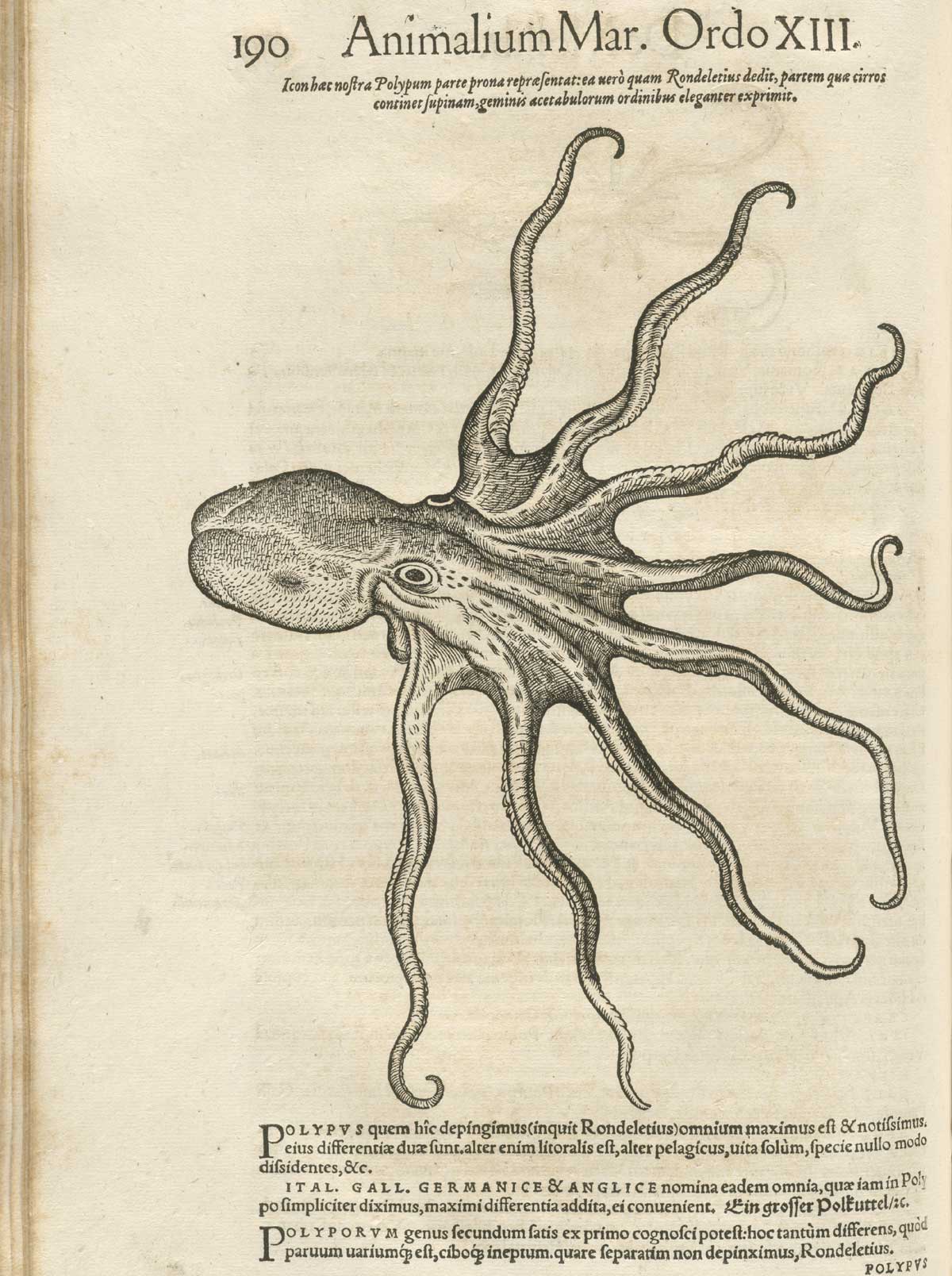
P Z Myers celebrates the web publication by the U.S. National Library of Medicine of several early illustrated scientific texts.

One of his favourites is an octopus from Conrad Gesner’s Historiae Animalium. I like this one of a hippo and a crocodile:

2 December 2009

The hercinia

The hercinia is a bird that is born in the Hercynian forest in Germany, from which it takes its name. It serves as a beacon for travellers because its feathers glow so brightly in the dark that they light up the path.
-- 'Bestiaria Latina'

16 October 2009

The panther's breath

According to the old books, the breath of the panther is delight:
From its mouth comes a sweet odour, as if it were a mixture of every perfume. Other animals, hearing its voice, follow wherever it goes because of the sweetness of its scent. Only the dragon is seized by fear and flees into the caves beneath the earth.
Under a lead sky in an old library I turned a page and saw what cannot be captured in print or on screen. The panther's breath shimmers in ribbed waves across the gold.

9 October 2009

A mediæval beauty cure

Crocodile dung can be used to enhance a person's beauty: the excrement (or the contents of the intestines) is smeared on the face and left there until sweat washes it off.
-- The Medieval Bestiary

11 November 2008

RNA 'bestiary'

...in this graphic, which is part of an NYT package that includes articles on an 'identity crisis' for the gene, the promise and power of RNA and looking beyond 'gene'.


The third article quotes Evelyn Fox Keller:
the notion of the gene as the atom of biology is very mistaken...DNA is a far richer and more interesting molecule than we could have imagined when we first started studying it.

15 September 2008

Hopeful hybrids


"If Lévi-Strauss is right," wrote Lewis Thomas,"myths are constructed by a universal logic that, like language itself, is as characteristic for human beings as nest-building is for birds." [1]

"Our powerful story [today]," Thomas continued, "equivalent in its way to a universal myth, is evolution. Never mind that it is true whereas myths are not; it is filled with symbolism, and this is the way it has influenced the mind of society."

Medieval bestiaries, he observed, do not contain, as a rule, totally novel creatures of the imagination made up of parts we have never seen before. "On the contrary, they are made up of parts that are entirely familiar. What is novel, and startling, is that they are mixtures of species." [2]


Thomas went on to suggest a bestiary for our time would have to be a microbestiary, featuring the likes of Myxotricha paradoxa, Blepharisma and plant-animal combinations that mostly exist in the sea. Their "meaning", he suggested, would be "basically the same as the meaning of a medieval bestiary. There is a tendency for living things to join up, establish linkages, live inside each other, return to earlier arrangements, get along, wherever possible."

Evolution may be today's "powerful story" [3], at least for those who manage to limit their magical thinking to where it does little harm (or even, possibly, some good [4]). But it is not the only one. Twisted, dark stories seem to fascinate millions.

Hope may come in part from a broader "story" of science -- the systematic achievement of greater knowledge and understanding -- with global projects like the LHC reinforcing the point that the cosmos is more majestical golden fire than foul congregation of vapours.


Footnotes:

[1] from Some Biomythology published in The Lives of a Cell (1974). But there are several reasons for thinking that Lévi-Strauss explained less than he imagined. To take one example, he cited Sigmund Freud to bolster his case, and Freud was out to lunch on evolution (see, for example, Freud's Evolutionary Fantasy by Stephen Jay Gould) and much else. Still, Thomas's observation about bestiaries seems worth keeping in mind.

[2] Contemporary games with bestiary-type elements, notably Spore, are also limited in striking ways. See here.

[3] We'd probably say "narrative" instead these days.

[4] (added 17 Sep) Some say a different kind of magical thinking from the one embedded in abstracted monotheisms is precisely what's needed. From David Abrams on The ecology of magic:
When the animate presences with whom we have evolved over several million years are suddenly construed as having less significance than ourselves, when the generative earth that gave birth to us is defined as a soulless or determinate object devoid of sensitivity and sentience, then that wild otherness with which human life had always been entwined must migrate, either into a supersensory heaven beyond the natural world, or else into the human skull itself--the only allowable refuge, in this world, for what is ineffable and unfathomable.


Images: Topsell's History of Four-footed Beasts (1607), the Manticore, simulation of Higgs Boson experiment.