4 November 2009

Take, eat; this is my body

Foer relates how, one night, he sneaked onto a California turkey farm with an animal-rights activist he calls C. Most of the buildings were locked, but the two managed to slip into a shed that housed tens of thousands of turkey chicks. At first, the conditions seemed not so bad. Some of the chicks were sleeping. Others were struggling to get closer to the heat lamps that substitute for their mothers. Then Foer started noticing how many of the chicks were dead. They were covered with sores, or matted with blood, or withered like dry leaves. C spotted one chick splayed out on the floor, trembling. Its eyes were crusted over and its head was shaking back and forth. C slit its throat.
-- from Elizabeth Kolbert's review of Jonathan Safran Foer's Eating Animals. Kolbert makes no mention of greenhouse gas emissions from livestock. [1] Does Foer?

The story goes that Franz Kafka visited the Berlin aquarium and, gazing into the illuminated tanks, addressed the fish directly. “Now at last I can look at you in peace,” he told them. “I don’t eat you anymore.”

But should we cut out meat (and fish) altogether? And, as Kolbert points out, what about all other animal products? Can one imagine a world where many fewer animals are kept in excellent conditions and only consumed on special occasions? If not, how about 'Meat 2.0?' (or its dark side 'secret burgers')?

Would a world in which humans eat no animals be palid, etiolated? A more sustainable (more plausible) alternative, perhaps, would be one with a smaller human population which both reveres and eats a limited number of animals, rather as some nomadic peoples still do today. [2], [3]

And then there is Kafka's hunger artist (with whom I have some sympathy).


Image: a lake of blood and excrement near Granjas Caroll, Mexico

Footnote

[1] An overview from more than a year ago but still useful is Andy Revkin's Can people have meat and a planet too?

[2] A non-dreadful scenario for reduction in the total size of the human population would most likely be an accelerated and peaceful demographic transition: billions of freely made choices by more and more people to have just one or two children. Global population would peak at about 9 billion mid century and start to decline thereafter. Quality of life would continue to improve: 'Malthus' well and truly vanquished.

[3] (added 7 Nov) Or, as John Berger sees it (Why look at animals? 1977), as peasants in agricultural societies have long done:
A peasant becomes fond of his pig and is glad to salt away the pork. What is significant, and is so difficult for the urban stranger to understand, is that the two statements in that sentence are connected by an and and not by a but.

'Escherichia Ophelia'

From Microbial art via Biophemera. The artist is JoWOnder

2 November 2009

A circle of life

In Why Animal Suffering Matters, Andrew Linzey argues that sentient animals, like children, should be accorded a special moral status.

I haven't read this book yet, and don't pretend to be up to speed with the philosophy and wider debates about animal rights, but I am aware that some philosophers and others identify at least one difference between children and animals which they regard as important: children are future adult humans whereas animals are not. Their capabilities and flourishing follow distinct paths. [1]

There is a good case for regarding non-human animals as different in significant ways from humans (but not necessarily of any less worth for that). There may also be a case for seeing children in different ways from how we often do in most 'modern' societies.

According to Hugh Brody's account, the Inuit believe their infants to be reincarnations of recently deceased grandparents. A mother may address her daughter as both 'daughter' and 'mother'. It would be impossible and silly to try and introduce such a belief into the industrial world. But we might have something to learn from the sense of trust, respect and reverence that such a belief brings with it for even the smallest and most vulnerable. Birth, life and death are greater than the individual ego.

Should only be sentient beings be worthy of 'special moral status'?


Footnote

[1] See, for example Martha Nussbaum. A more radical view, perhaps, is taken by James Rachels.

1 November 2009

Eternal return

The little ones have left us, slipping into the lacy whitewater and under the hem of the ocean, entering the great swim, never pausing to ask ‘what if,’ using everything they know, with all they’ve got.
-- Carl Safina

30 October 2009

Soundings

This blog consists of notes made in passing for a much larger project that I've been working on for a couple of years. In course of both the blog and the larger project all kinds of things get dragged up on deck: sometimes rubbish, sometimes a puzzle and occasionally something truly astonishing.

29 October 2009

Names

There are terms [in Inuktitut] to mean arctic char, arctic char that are running upstream, arctic char that are moving down to the sea and arctic char that remain all year in the lake, as well as words for lake trout, salmon and so on. There is no word that means “fish”. Similarly, there are Inuktitut words for ringed seal, one-year-old ringed seal, adult male ringed seal, harp seal, bearded seal and so on. There is not word that means “seal”. Speakers of Inuktitut have to have precise information about the seals to which they refer. These are ways, perhaps, in which hunter-gatherer languages express, celebrate and enforce the importance of detailed knowledge of the natural world.
-- Hugh Brody (2000)

28 October 2009

Cool star

We have discovered a quite novel thermoregulation strategy in the animal kingdom
-- Sylvain Pincebourde, as quoted in BBC report

Leatherback

Billy Collins says poetry should displace silence, so that before the poem there is silence, and afterward, silence again. A sea turtle, suddenly appearing at the surface for a sip of air, displaces water. And afterward, water still. This is the turtle's poetry, a wordless eloquence stated in silence and, in a moment, gone.
-- Carl Safina

27 October 2009

Robot good robot bad

Glancing at the robot, Mary lifted a magazine from the top of the pile and guided it into a rack on top of the shelf. As soon as the magazine was in place, the robot emitted a beep. During the next few minutes, Mary moved each magazine, one by one, to the rack. Gradually, she increased her pace, and the beeps from the robot came faster. Mary began to laugh.
She turned and looked squarely at the robot. With a sly smile, she moved her weak arm toward the remaining magazines on the desk and mimed putting one into the rack. She then stuck her tongue out at the machine.
Matarić said, “She is cheating. She is totally thrilled, because she thinks she cheated the robot.” The robot, though, was on to the game. A reflective white band that Mary wore on her leg allowed the robot to follow her movements. A thin motion sensor attached to her sleeve transmitted Mary’s gestures to the robot, so that it knew almost instantly whether she was raising her arm and in what motion. A sensor in the rack signalled the robot when a magazine was properly placed, and the robot communicated with Mary only when she performed the task correctly.
Although the task lasted about an hour, the novelty of the interaction did not seem to wane. In a debriefing after the study, Mary said, “When I’m at home, my husband is useless. He just says, ‘Do it.’ I much prefer the robot to my husband.”
-- from Robots that Care by Jerome Groopman.
"Drones are a technological step that further isolates the American people from military action, undermining political checks on...an endless war" [says Mary Dudziak]...

...there is no longer any doubt that targeted killing with drones has become official U.S. policy. "The thing we were complaining about from Israel a few years ago we now embrace", [Gary Solis] says. Now, he notes, nobody in government calls it assassination...

...It appears to have taken sixteen missile strikes , and fourteen months, before the C.I.A succeeded in killing Baitullah Mehsud. During this hunt, between two hundred and seven and three hundred and twenty one additional people were killed.
-- from The Predator War by Jane Mayer.

Disease

The researchers believe their discovery is the first clear evidence of bacterial pathogens crossing over from humans to animals and then spreading, since animals were first domesticated 10,000 years ago.
-- report

Memory

For the human condition, writes Yadin Dudai:
forgetting is at least as important as remembering - sometimes more so. Without it, we are all bound to lead the miserable life of A. R. Luria's patient Solomon Shereshevsky, who was crippled by his boundless, indelible memory, or his fictional counterpart, Jorge Luis Borges's Funes. No forgetting implies no generalisation, no real present time, no amelioration of trauma, and no weaving of meaningful life narratives.
This is right enough, but as Dudai acknowledges, societies as a whole -- and on occasions individuals within them -- may benefit from the ability to recall everything about some things. The question, then, is who controls access to supra-individual memory and how?

26 October 2009

Seeing the light

Last year, scientists discovered that [Mantis shrimps] can...see circularly polarised light, which travels in the shape of a helix. To date, they are still the only animal that can see these spiralling beams of light.

The secret lies at a microscopic level. Each eye is packed with light-sensitive cells called rhabdoms that are arranged in groups of eight. Seven sit in a cylinder and each has a tiny slit that polarised light can pass through if it's vibrating in the right plane. The eighth cell sits on top and its slit is angled at 45 degrees to the seven below it. It's this cell that converts circularly polarised light into its linear version.

In technical terms, the eighth cell is a "quarter-wave plate", because it rotates the plane in which light vibrates. Similar devices are also found in camera filters, CD players and DVD players but these man-made versions are far inferior to the mantis shrimp's biological tech.
-- Ed Yong reports on a paper by N.W. Roberts et al.


By contrast some of the simplest known eyes consist of only two cells.

23 October 2009

A dead whale

Cutting up a whale is surprisingly easy. The animal has a thick layer of fat - the blubber - which is easily sliced. Removing the bones is less simple, as you need to know where the joints are, like when carving a roast. The flipper is composed of the same bones as our arms - humerus, radius, ulna and a ball-and-socket joint. Nick feels for this with his knife and soon we are able to free it. Removed from the whale, the flipper is enormous, the ball joint itself the size of a football. It slides down the side of the whale, landing with a huge splash in a pool of blood. We whoop with delight.
-- Adrian Glover

22 October 2009

Round earth's imagin'd corners

Some quick comments on Josie Appleton's The Challenge of Climate Change: Towards human species consciousness. [1] Appleton writes:
we know that at some point in the far-distant future, our sun will die. This will be at least a billion years, which is "forever" for practical purposes, but we cannot escape the fact that the universe is a temporal creation and so are we. At this point if not before, humans would become extinct. If we are the only conscious life in the universe then that would be that: mind would be gone. So it may be that at some point in the far-distant future, we will have to act as a species to create or recreate a star. Whether or not this actually happens, it’s good to imagine it.
Humans are likely to be long gone before it becomes possible to 'reboot' a star. All the same, Appleton may be right that the thought experiment is worthwhile. David Deutsch anticipated this in The Fabric of Reality (1997):
The colour of the sun ten billion years hence depends...on what people do: what decisions they make, what problems they solve, and on how they behave towards their children.
One could make a case, though, for acceptance. Is an end to all consciousness in the remote future really a bad thing?

For the nearer term, Appleton picks up on Vladimir Vernadsky:
Vernadsky’s humanist utopia would mean a far more vibrant and varied nature than we have at present. The "wider creative possibilities" of reorganising nature around human desires could in fact mean a munificence of animals, plants and ecosystems. Crucially, man is a producer and not just a consumer of nature; part of his productive activity is to make nature, by planting trees, breeding animals, setting up wildlife reserves.
Certainly, given the grim possibilities arising from careless human action, it's good to have a positive vision of the shared ecological future. Almost certainly, humans will increasingly shape nature, including by developing new life forms and, perhaps, intelligences. But caution will be needed in "reorganising nature around human desires." To avoid catastrophe (consequent upon 'darker' aspects of human nature) it may be necessary to reorganise human desires themselves (assuming this can be done at all and, if it can, be done without degrading humans).

Finally, Appleton concludes:
Imaginative possibilities could lay a path for technological and political possibilities, and the slow evolution of a human species consciousness.
I suspect, though, that it is scientific and technological possibilities that lay the path and that, by and large, human imagination and politics follow.


Earth and Moon from Mars orbiter

Footnote

[1] See also Rethink: a new improbable form of life by Emma Ridgway

Animal house

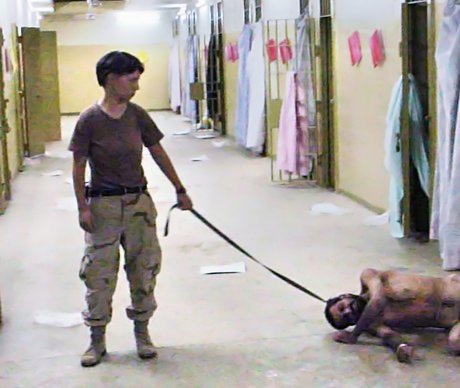
[Franz Kafka's] In the Penal Colony opens with an unforgettable portrait of the condemned man in chains, held by a lead by his guard as if to anticipate the grinning Lynndie England and the cringing detainee, leashed and naked, known to the night shift as ‘Gus’:

In any case, the condemned man looked so much like a submissive dog that one might have thought he could be left to run free on the surrounding hills and would only need to be whistled for when the execution was due to begin.

The...descendants of Kafka’s warders [are visible through] the interrogation log of Detainee 063, aka Mohammed al-Qahtani, the so-called twentieth hijacker, at Guatanamo:

11 Dec 2002

Detainee was reminded that no one loved, cared or remembered him. He was reminded that he was less than human and that animals had more freedom and love than he does. He was taken outside to see a family of banana rats. The banana rats were moving around freely, playing, eating, showing concern for one another. Detainee was compared to the family of banana rats and reinforced that they had more love, freedom, and concern that he had. Detainee began to cry during this comparison

20 Dec 2002

Detainee offered water - refused. Corpsman changed ankle bandages to prevent chafing. Interrogator began by reminding the detainee about the lessons in respect and how the detainee had disrespected the interrogators. Told detainee that a dog is held in higher esteem because dogs know right from wrong to protect innocent people from bad people. Began teaching the detainee lessons such as stay, come, and bark to elevate his social status up to that of a dog. Detainee became very agitated.
-- from On Art and War and Terror by Alex Danchev.

21 October 2009

The question concerning technology

The two views, that technology is a thing directing our lives, and simultaneously a thing blessedly serving our lives, are simultaneously valid. But together they cause unease, an ongoing tension that plays out in our attitude to technology and in the politics that surround it. This tension does not just come from technology causing us to exploit nature and from it determining much of our lives. It arises because for all of our human existence we have been at home in nature -- we trust nature, not technology. And yet we look to technology to take care of the future -- we hope in technology. So we hope in something we do not quite trust.

Technology...is the programming of nature, the orchestration & use of nature's phenomena. So in its deepest sense it is natural, profoundly natural. But it does not feel natural.
-- from The Nature of Technology by W. Brian Arthur. He concludes:
Our unconscious makes a distinction between technology as enslaving of [human] nature versus technology as extending our [human] nature. This is a correct distinction.

20 October 2009

Let's rock

The picture painted by Russell and Martin is striking indeed. The last common ancestor of all life was not a free-living cell at all, but a porous rock riddled with bubbly iron-sulphur membranes that catalysed primordial biochemical reactions. Powered by hydrogen and proton gradients, this natural flow reactor filled up with organic chemicals, giving rise to proto-life that eventually broke out as the first living cells - not once but twice, giving rise to the bacteria and the archaea.

Many details have yet to be filled in, and it may never be possible to prove beyond any doubt that life evolved by this mechanism. The evidence, however, is growing. This scenario matches the known properties of all life on Earth, is energetically plausible - and returns [Peter] Mitchell's great theory to its rightful place at the very centre of biology.
-- from Was our oldest ancestor a proton-powered rock? by Nick Lane

Bright fish

A series of studies has recently revealed that [coral] reef fish are surprisingly adaptable. Freshly caught wild fish quickly learn new tasks and can learn to discriminate among colors, patterns and shapes, including those they have never encountered. These studies suggest that learning and interpreting new stimuli play important roles in the lives of reef fish.
-- Sean B Carroll reports

Reef as metaphor:
Technology is “alive” in the sense that a coral reef is alive. The reef is an ecological system with many species, and technology in the broadest sense is an elaborate and constantly changing structure made up of thousands of discrete technologies, themselves composed of separate technologies.