During the year or so that [the lives of my old dogs Nina and Tess] overlapped with that of my [new young] son, I was alternately touched, shocked, amazed, and dumbfounded by the kindness and patience they exhibited towards him. They would follow him from room to room, everywhere he went in the house, and lie down next to him while he slept. Crawled on, dribbled on, kicked, elbowed and kneed: these occurrences were all treated with a resigned fatalism. The fingers in the eye they received on a daily basis would be shrugged off with an almost Zen-like calm. In many respects, they were better parents than me. If my son so much as squeaked during the night, I would instantly feel two cold noses pressed in my face: get up, you negligent father — your son needs you.-- from The Kindness of Beasts by Mark Rowlands
Showing posts with label dog. Show all posts
Showing posts with label dog. Show all posts
24 October 2012
Dog days


17 September 2012
Of cruelty
Looked at casually, day-old puppies are little, blind, squirming, undifferentiated objects of things. I put one of them in the bucket of water, and instantly an extraordinary, terrible thing happened. This blind, amorphous thing began to fight desperately for its life, struggling, beating the water with its paws. I suddenly saw that it was an individual, that like me it was an 'I', that in its bucket of water it was experiencing what I would experience and fighting death, as I would fight death if I were drowning in multitudinous seas.
-- Leonard Wolf quoted by Sarah Bakewell
22 October 2011
C.S.I.: Dog Dump

‘Globally endangered Egyptian vulture!’ shouted Çağan, slamming on the brakes. Glancing skyward, I caught a glimpse of something brown flapping away. The body of the Egyptian vulture is brown and off-white, but its face is bright yellow. ‘They get that colour from eating shit, which is full of yellow carotenoid pigments,’ Çağan explained. In males, the bright-yellow face is an indicator of fitness and virility, signaling a capacity to eat enormous quantities of shit without getting sick.-- from Natural Histories: A journey in the shadow of Ararat by Elif Batuman
On behalf of the Egyptian vulture, as well as the region’s other vulture species Çağan had recently opened a ‘vulture restaurant’...which in its pilot phase had served mostly dead dog. Emrah, Çağan’s science coordinator, was charged with retrieving dog carcasses from the city dumps and depositing them in random locations around Aras, to see how the vultures reacted. The vultures reacted well. You bring the dead dog, and the vultures take care of the rest. The one problem was that a lot of dogs in the dumps had been poisoned as part of a stray-dog reduction program.
...Thus began a phase of Emrah’s life that might have been called “C.S.I.: Dog Dump”: did this dog die of natural causes, or was it poisoned? He started out bribing the staff at the dumps, a pack of cigarettes for every clean carcass. It was a good system, although Emrah inevitably began asking himself certain questions. Was it for this that he had completed his master’s in biology? Further, the workers at the dump clearly thought he was some kind of pervert. One of them once remarked that Emrah might not find that day’s dog suitable: “The thing is, this one is male.”
22 October 2009
Animal house
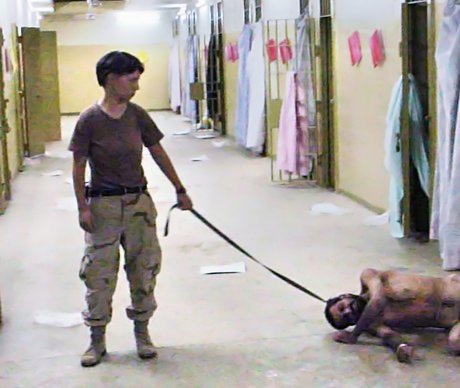
[Franz Kafka's] In the Penal Colony opens with an unforgettable portrait of the condemned man in chains, held by a lead by his guard as if to anticipate the grinning Lynndie England and the cringing detainee, leashed and naked, known to the night shift as ‘Gus’:-- from On Art and War and Terror by Alex Danchev.
In any case, the condemned man looked so much like a submissive dog that one might have thought he could be left to run free on the surrounding hills and would only need to be whistled for when the execution was due to begin.
The...descendants of Kafka’s warders [are visible through] the interrogation log of Detainee 063, aka Mohammed al-Qahtani, the so-called twentieth hijacker, at Guatanamo:
11 Dec 2002
Detainee was reminded that no one loved, cared or remembered him. He was reminded that he was less than human and that animals had more freedom and love than he does. He was taken outside to see a family of banana rats. The banana rats were moving around freely, playing, eating, showing concern for one another. Detainee was compared to the family of banana rats and reinforced that they had more love, freedom, and concern that he had. Detainee began to cry during this comparison
20 Dec 2002
Detainee offered water - refused. Corpsman changed ankle bandages to prevent chafing. Interrogator began by reminding the detainee about the lessons in respect and how the detainee had disrespected the interrogators. Told detainee that a dog is held in higher esteem because dogs know right from wrong to protect innocent people from bad people. Began teaching the detainee lessons such as stay, come, and bark to elevate his social status up to that of a dog. Detainee became very agitated.
23 April 2009
Red dog

Ruppy the transgenic puppy at 10 days old under ultraviolet light, showing the red fluorescent protein produced by sea anemones.
15 April 2009
The totality of dogs
The flawed genius of language, the premier instrument of our collectivized consciousness, is to give us the ability to encompass in a virtual way huge territory that we could not otherwise experience or interact with. The central feature of language – that we seem to get hold of things via their general classes – is the key to this. When I say “dog” I do not take hold of any particular dog, but I have brought into play the totality of dogs available for my characterization. Thinking about this gives us a new angle on the venerable philosophical problem of universals – on the mysterious relations between singular objects and the general terms through which we take hold of them – and further, on what Slavoj Zizek has called ‘the violence of language’ (which, incidentally, licenses other modes of violence).-- Raymond Tallis
In short, properly reflected upon, knowingness and other shallows shine a light into the depths of our uniquely human consciousness, and upon the processes by which individually we make this world, that vastly outsizes us, our own place.

26 January 2009
Dogs and children
A second post with a dog connection today. I've just been at Desert Blues: readings by Patience Agbabi, Melanie Challenger and David Constantine, and music by the Adriano Adewale Group. Constantine read, among other things[1], from his translation of Brecht's Children's Crusade:
Footnote
1. One of the other poems Constantine read from Nine Fathom Deep was Pity. He introduced it saying "I had the notion that if there were more monsters and hybrids left we might have a better idea of what we were doing". See Montaigne, On a monster-child (Essays, book 2)
In Poland that January [1940]
A dog was caught, it had
A cardboard round its soggy neck
With writing on it that said
"Please help us, we are lost.
We can’t find the way anymore
We are fifty-five. This dog will lead
You to where we are
And if you can’t come, drive him away
Don’t shoot at him, he is
The only living creature
Who knows the way to us."
The writing was a child’s
Peasants read it aloud.
That was a year a half ago
The dog hungered and died.
Footnote
1. One of the other poems Constantine read from Nine Fathom Deep was Pity. He introduced it saying "I had the notion that if there were more monsters and hybrids left we might have a better idea of what we were doing". See Montaigne, On a monster-child (Essays, book 2)
Dog days
Alexander Fiske-Harrison wishes The Philosopher and the Wolf had included a section on what it is like to be a wolf. Perhaps Temple Grandin is helpful. Consider, for example, this from an essay on consciousness in animals and people with autism:
Chimpanzees have self awareness. When they look at themselves in a mirror, they do not react to the image as if it was another animal, and if paint is applied to the chimps face, it will try to wipe it off. Because dogs are not able to do this, one should not jump to the conclusion that dogs are not self aware. Dogs may not be visually self aware, but are possibly smell self aware. A dog marking its territory is able to discriminate between its own urine and a strange dog's urine.I am not a 'dog person' but I think I can understand what it is like to be one from observation, and from Pablo Neruda's A Dog Died (linked on right hand side of this page)
6 December 2008

25 November 2008

24 July 2008
Les chiens, les pensées
Quietly [Gilbert] adds that the soldiers also murdered 37 members of his family.-- from The forgotten French village massacre.
"My little cousins," he says, "I still can't forget the little cousins you see, I used to play with them and they were so..."
But then his voice trails away and I can see him pushing the memory back under.
Instead he tells me his story of survival, how for two nail-biting hours his mother, sisters and the two sheep dogs hid silently in a stream under a bridge while unsuspecting German officers yelled orders above them.
"Why didn't they discover us?" Gilbert asks. "Why didn't the sheep dogs who always barked at loud noises, give us away?"
Subscribe to:
Posts (Atom)